Hands-On AI & HPC Learning
for Every EE Student
At Carleton University’s Department of Electronics, we recognize that the pace of technological change—particularly in Artificial Intelligence (AI)—is accelerating at an unprecedented rate. Engineers must now be proficient not only in foundational circuit theory and design but also in simulation, modeling, and the strategic use of AI tools. The AI & HPC Exploratorium was created to meet this need, offering students practical exposure to advanced CAD platforms, high-performance computing (HPC) infrastructure, and AI frameworks that are rapidly transforming engineering workflows.
Serving approximately 600 undergraduate students annually, the Exploratorium is a high-end computing facility where students can engage directly with industry-relevant technologies. Equipped with multi-GPU Linux workstations and software platforms such as MATLAB, Cadence, Synopsys, and PyTorch, the lab supports projects ranging from analog circuit simulation and hardware verification to AI-accelerated design and model-based control systems.
Students access structured labs, guided tutorials, and peer-led workshops that demystify both AI and simulation tools. Whether training neural networks, optimizing signal chains, or performing system-level modeling, they build hands-on competence in the tools that define modern electrical engineering practice. The space is designed not only for coursework but also for exploration and experimentation—allowing students to test ideas, fail quickly, and iterate in a resource-rich environment.
By embedding AI and HPC into the undergraduate experience, the Exploratorium ensures our students are equipped for a discipline in transition. It bridges the gap between traditional EE training and the computational paradigms now reshaping everything from biomedical sensing to communication systems. This is where electrical engineers learn to think computationally—and to engineer intelligently.
Why Learn AI & HPC?
AI, modeling, simulation, and high-performance computing are integral to modern applications in areas like autonomous systems, advanced signal processing, and complex system design. They offer the computational power and flexibility essential in today’s engineering landscape.
Hands-on experience with these technologies enhances employability and prepares you for industry demands. At Carleton, our students gain practical skills that set them apart in the job market.
The Exploratorium provides access to powerful hardware and software, fostering practical skills over theoretical exercises. This approach ensures you’re ready to tackle real-world engineering challenges.
- Practical skills with AI toolchains.
- CAD, simulation, and system-level design training.
- Exposure to HPC and local LLM tools.
What We Offer
The center provides a dynamic learning ecosystem with resources and opportunities to excel in AI, HPC, and advanced system design.
GPU-Accelerated Workflows
Engage in practical exercises using GPU-accelerated tools for AI model training, complex simulations, and high-performance data analysis.
AI and Modeling Projects
Bring your innovative ideas to life. Tackle projects ranging from developing machine learning models to designing and simulating complex electronic systems.
Industry Collaboration
Participate in research projects in collaboration with leading tech companies, addressing real-world challenges in AI, HPC, and CAD tool development.
Expert Support & Resources
Access curated tutorials, AI framework guides, HPC activities, workshops, and peer assistance from student assistants in a supportive environment.
Enterprise-Class Linux Workstations
Get hands-on with powerful Linux workstations equipped with multiple GPUs, fast NVMe storage, and access to leading AI and CAD software suites.
Multilevel System Design
Develop skills progressively, from basic AI model implementation and circuit simulation to complex system-on-chip (SoC) design and HPC cluster utilization.
About the AI & HPC Exploratorium
The AI & HPC Exploratorium at Carleton University is a dynamic hub where electrical engineering students gain invaluable hands-on experience with Artificial Intelligence and High-Performance Computing. Annually supporting approximately 1,950 students across four core courses, our center is designed to empower learning and innovation.
Self-Paced Learning
Explore a rich library of tutorials and guides on AI frameworks and HPC tools at your own speed, building a strong foundation in these advanced concepts.
Peer Support & Workshops
Benefit from collaborative learning through peer support and engaging workshops tailored for students at all skill levels in AI and HPC.
Culture of Experimentation
Located in the Department of Electronics, we foster an environment that encourages experimentation with cutting-edge technologies, helping you develop critical skills for modern engineering challenges.
Visit Us
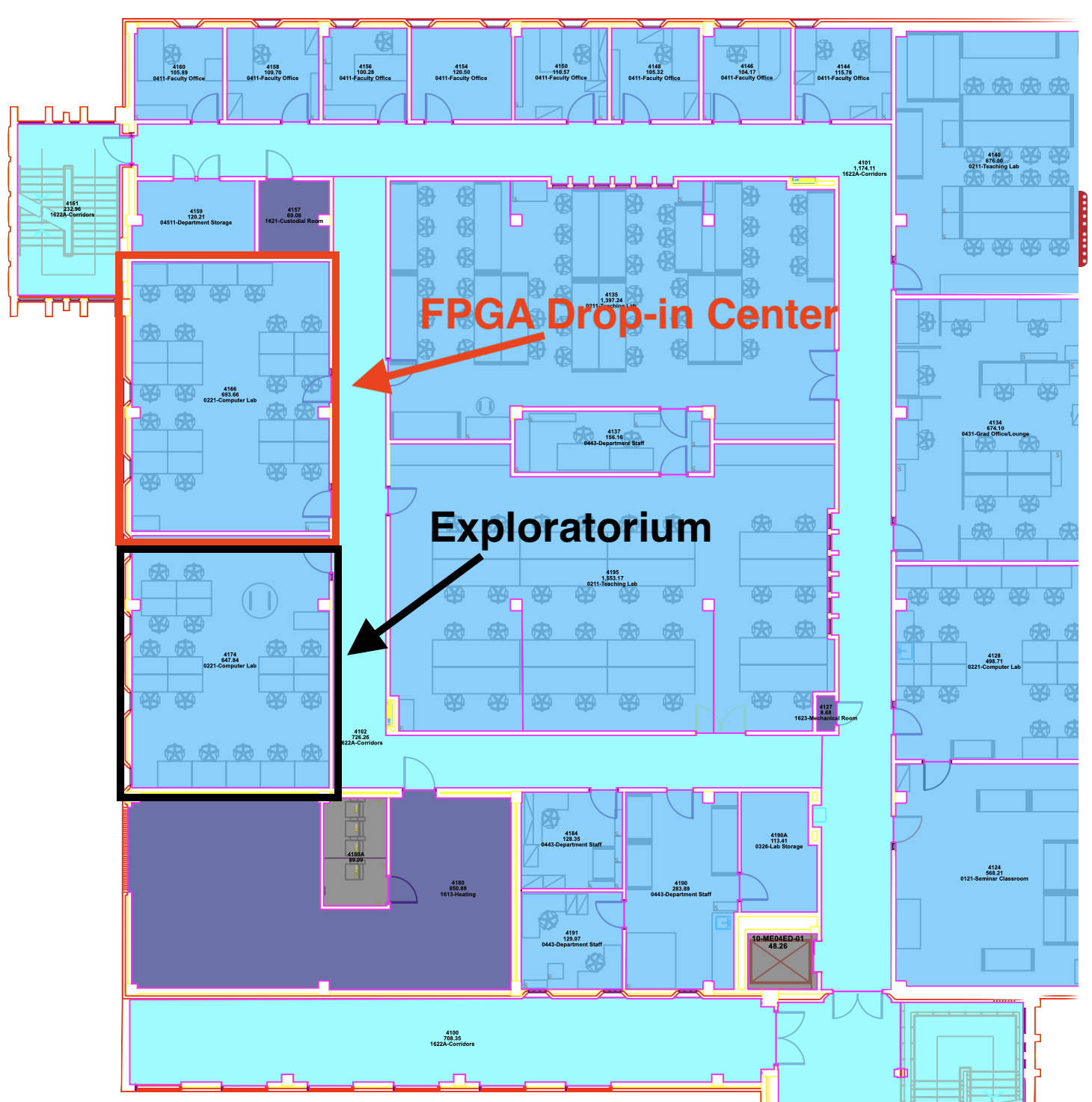
Location
Room 4174, Mackenzie Building
(Beside the FPGA Drop-In Center)
Hours of Operation
Regular Access: Mon - Fri, 9:30 AM - 5:30 PM
Extended Card Swipe Access:
- Weekdays: Until 11:00 PM
- Weekends: 9:30 AM - 8:00 PM
Promoting Use
On many campuses, drop-in centers suffer from underuse and despite good intentions, students often don’t see a compelling reason to visit. At the AI & HPC Exploratorium, we’re deliberately designing against that trend. Here’s how:
Strategic Location
The center is situated directly adjacent to the undergraduate teaching labs, making it easy and natural for students to stop by before, between, or after classes and labs. Convenience eliminates the first barrier to use.
Expert Peer Support
The center will be staffed by knowledgeable student mentors—peers who understand the course material and can offer relevant, real-time assistance. This transforms the space from a passive resource to an active support hub.
High-Quality Equipment
We’re investing in top-tier hardware and tools. Students will want to use the space not only because they need help, but because the equipment is better than what’s available elsewhere. The lab experience will feel premium, not remedial.
Responsive Operating Hours
Hours will be aligned with student schedules, especially targeting times when coursework demands are highest. This ensures the center is open when it’s actually needed, including evenings or weekends if required.
Proactive Promotion
We’re not relying on word-of-mouth. The center will be actively promoted through class announcements, department channels, posters, and social media. Students will know it exists, what it offers, and why they should go.
Course Tie-ins
The center provides direct support for students enrolled in AI & HPC-related courses, offering tailored assistance for labs, assignments, and projects, ensuring they can successfully apply classroom concepts.
By focusing on utility, environment, access, and visibility, the Exploratorium is designed to be used.
Supported Courses
The Exploratorium provides resources and support for a variety of courses, enabling students to apply AI and HPC concepts to their studies.
ELEC 2501
Circuits and Signals: Understanding complex circuit behaviors can be enhanced through simulation tools, allowing students to visualize and analyze signal processing in real-time.
ELEC 2507
Electronics I: Hands-on experience with AI-driven design tools can aid in the development and testing of electronic components, fostering a deeper comprehension of electronic systems.
ELEC 2602
Electric Machines and Power: Simulating electric machine operations using high-performance computing can provide insights into efficiency and performance optimization.
ELEC 2607
Switching Circuits: Leveraging AI algorithms to design and test switching circuits can streamline the learning process and highlight practical applications.
ELEC 3500
Digital Electronics: Utilizing AI frameworks can assist in the design and simulation of digital systems, enhancing students' understanding of digital logic and circuit design.
ELEC 3509
Electronics II: Advanced modeling and simulation tools can facilitate the exploration of complex electronic systems, promoting a hands-on learning environment.
ELEC 3907
Engineering Project: Access to AI and HPC resources can support students in developing innovative solutions and conducting comprehensive analyses for their capstone projects.
ELEC 4601
Microprocessor Systems: Integrating AI techniques can enhance the design and optimization of microprocessor-based systems, preparing students for industry challenges.
ELEC 4907
Engineering Research Project: This self-directed research course is ideally suited to benefit from the Exploratorium’s resources, allowing students to implement advanced simulations, leverage AI models, and utilize high-performance infrastructure to pursue original research in electronics and computing.
Software and Hardware
Software
Access industry-standard and open-source tools for AI, HPC, and CAD:
- Cadence Virtuoso: For custom IC design, simulation, and layout.
- Synopsys Design Suite: Comprehensive tools for digital and analog design.
- MATLAB and Simulink: For numerical computation, simulation, and model-based design.
- PyTorch: Open-source machine learning framework.
- TensorFlow: End-to-end open-source platform for machine learning.
- Jupyter Notebooks: For interactive computing and data analysis.
- CUDA Toolkit & cuDNN: For GPU-accelerated computing.
- Slurm Workload Manager: For managing HPC cluster resources.
- Various Compilers & Libraries: GCC, Clang, OpenMPI, Intel MKL, etc.
Supported by vendor documentation, university programs, and online resources.
Hardware
State-of-the-art hardware for demanding computational tasks:
- Multi-GPU Servers: High-performance servers with multiple NVIDIA GPUs for AI training and HPC.
- Linux Workstations: Powerful desktop systems with high-core CPUs, ample RAM, and professional GPUs.
- High-End Displays: Large, high-resolution monitors for detailed design and visualization.
- NVMe Storage: Fast solid-state drives for rapid data access and large datasets.
- Remote Compute Access: Secure remote access to HPC clusters and specialized servers.
Equity, Diversity, and Inclusion
At the AI & HPC Exploratorium, we are dedicated to fostering an educational environment that champions equity, diversity, and inclusion (EDI). We recognize that a multitude of voices and experiences are essential for driving innovation in the field of AI, HPC, and beyond.
Welcoming All
We actively encourage participation from individuals of all races, ethnicities, genders, gender identities and expressions, sexual orientations, ages, abilities, socio-economic backgrounds, religions, and all other dimensions of diversity.
Accessible Learning
We aim to provide resources and instruction that are accessible and cater to diverse learning styles. We are committed to making reasonable accommodations. Please contact us if you have specific accessibility needs.
Respectful Environment
We are dedicated to maintaining a respectful, collaborative, and harassment-free learning space for all participants, instructors, and staff.
Breaking Down Barriers
We acknowledge that systemic barriers can discourage individuals from underrepresented groups. Our workshops aim to be a positive, empowering entry point into AI & HPC. This includes outreach with groups like IEEE Women in Engineering.
Empowering Voices
We believe that every voice matters. We encourage participants to share their ideas, feedback, and perspectives to help shape the future of the Exploratorium. Your input drives innovation and inclusivity in our programs.
Continuous Improvement
We are committed to ongoing learning and refinement of our EDI practices and welcome feedback from our community on how we can better serve everyone.
Join our workshops to gain new skills, connect with peers, and be part of an inclusive tech community.
Industry Partnerships
The AI & HPC Exploratorium at Carleton University is committed to building strong ties with industry leaders in AI, high-performance computing, and CAD tool development. These partnerships create pathways for job placements and long-term career opportunities in electrical and computer engineering. We collaborate with companies to integrate real-world perspectives and cutting-edge tools into the student experience.
Many projects at the exploratorium are inspired by or co-developed with our industry partners, ensuring that students work on challenges that mirror current industry needs. This includes optimizing AI models, developing HPC applications, or utilizing advanced CAD tools for complex system design. Such projects provide practical experience that aligns with professional demands, giving students a competitive edge.
Industry partners actively contribute through workshops, guest lectures, and hackathons, offering hands-on opportunities to collaborate with professionals and explore state-of-the-art applications. These events enhance technical skills and facilitate networking, often leading to internships and job offers. We also seek support for software licensing, access to specialized cloud computing resources, and co-developed learning content to ensure our curriculum remains at the forefront of technological advancements.
Additionally, the exploratorium benefits from strong industry guidance on curriculum development and equipment selection, ensuring that students use the most modern tools and techniques employed by leading companies. This exposure to industry-standard practices prepares students for seamless transitions into professional roles, equipping them with the skills and confidence needed to excel in their future careers in AI, HPC, and beyond.
Industry Sponsors
We are proudly supported by leading industry partners who share our commitment to fostering engineering talent and innovation. Their generous contributions and collaboration are invaluable to our success.


Contact Us
Reach out to learn more or get involved!
Email: chair@doe..carleton.ca
Department of Electronics, Carleton University