Hands-On FPGA Learning
for Every EE Student
At Carleton University’s Department of Electronics, we prioritize hands-on learning to prepare undergraduate electrical engineering students for their careers. Field-Programmable Gate Arrays (FPGAs) are powerful tools used in fields like signal processing, communications, and embedded systems, but many students are unfamiliar with them when they begin their studies. Our FPGA Drop-In Center addresses this gap by introducing students to FPGAs and providing the resources to explore and master them.
Serving approximately 1,950 students each year, the drop-in center is a welcoming space where students of all skill levels can work with FPGA development boards. Through practical labs, guided tutorials, and peer-supported workshops, students learn to design and test circuits, gaining confidence with FPGAs. The center supports four core courses, offering projects like building logic circuits or programming embedded systems. This approach ensures every student, regardless of prior experience, can engage with FPGAs and develop valuable skills for industry and research.
By making FPGAs accessible and providing clear, structured support, the drop-in center helps students move from curiosity to competence. It’s a place where learning by doing builds a strong foundation for electrical engineering success.
Why Learn with FPGA?
FPGAs are integral to modern applications like AI, signal processing, and embedded systems. They offer flexibility and performance, making them essential tools in today’s engineering landscape.
Hands-on experience with FPGAs enhances employability and prepares you for industry demands. At Carleton, our students gain practical skills that set them apart in the job market.
The Drop-In Center provides access to real hardware, fostering practical skills over simulations. This approach ensures you’re ready to tackle real-world engineering challenges.
- Real-world applications in AI and DSP.
- Enhanced career prospects.
- Practical, hands-on learning.
What We Offer
The center provides a dynamic learning ecosystem with resources and opportunities to excel.
Hands-On Labs
Engage in practical lab exercises integrated into core EE courses, experimenting in controlled environments with state-of-the-art FPGA boards.
Project Development
Bring your innovative ideas to life. Tackle projects ranging from basic logic circuits to complex SoC designs and hardware accelerators.
Industry Collaboration
Participate in research projects in collaboration with leading tech companies like Findus, AMDD, and Zilink, addressing real-world challenges.
Expert Support & Resources
Access curated tutorials, Verilog guides, FPGA activities, workshops, and peer assistance from student assistants in a supportive environment.
State-of-the-Art Boards
Get hands-on with a portfolio of AMD/Xilinx developer boards, including Basys 3 for introductory concepts, Nexys A7 for advanced exploration, and PYNQ-Z2 for SoC and Python-based development.
Progressive Learning Pathway
Develop skills progressively, from blinking LEDs and basic logic gates to UART/SPI communication, DSP blocks, and full embedded system integration on FPGAs.
About the FPGA Drop-In Center
The FPGA Drop-In Center at Carleton University is a dynamic hub where electrical engineering students gain invaluable hands-on experience with Field-Programmable Gate Arrays (FPGAs). Annually supporting approximately 1,950 students across four core courses, our center is designed to empower learning and innovation.
Self-Paced Learning
Explore a rich library of tutorials and Verilog guides at your own speed, building a strong foundation in FPGA concepts and design.
Peer Support & Workshops
Benefit from collaborative learning through peer support and engaging workshops tailored for students at all skill levels.
Culture of Experimentation
Located in the Department of Electronics, we foster an environment that encourages experimentation, helping you develop critical skills for modern engineering challenges.
Visit Us
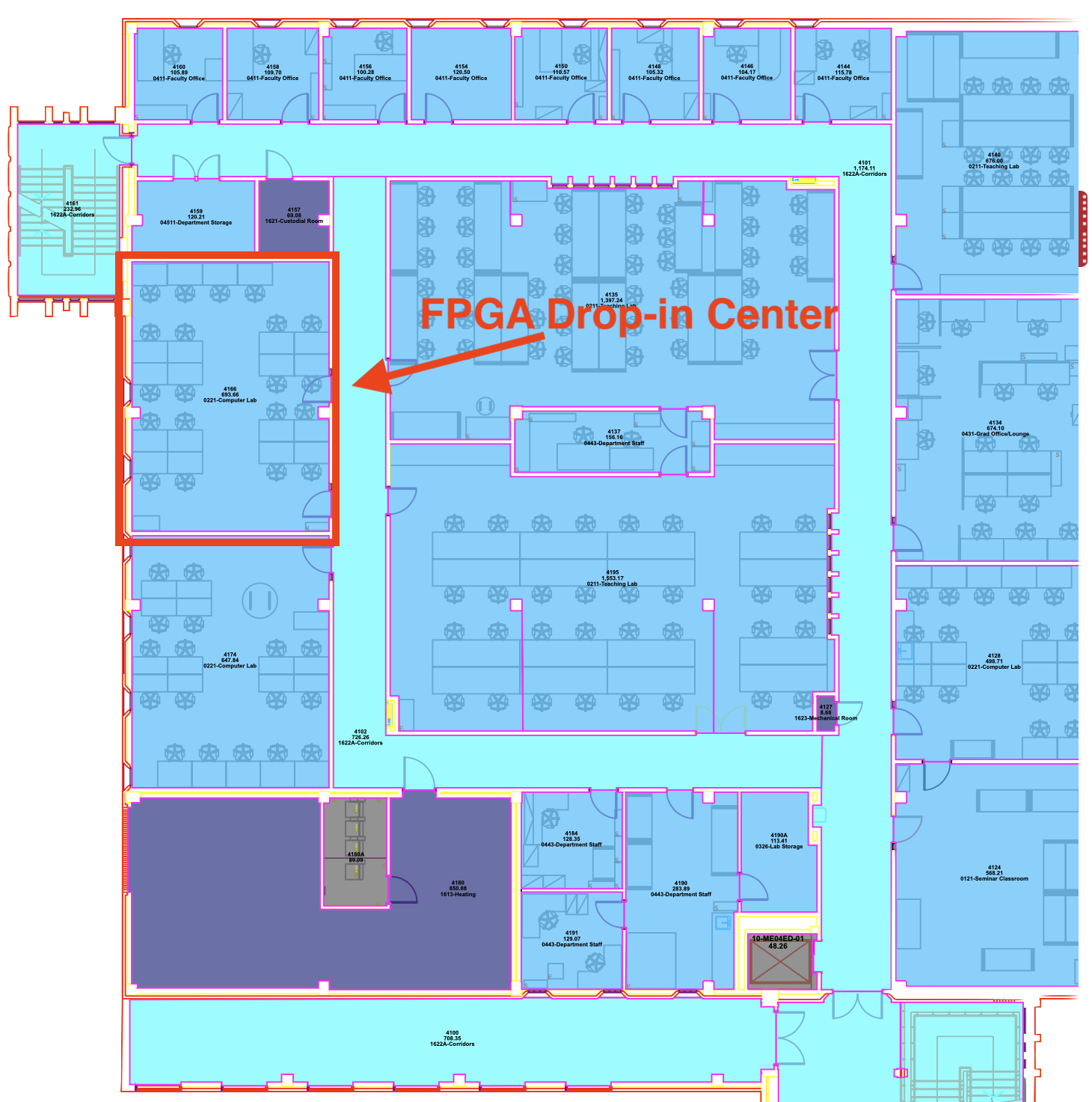
Location
Room 4166, Mackenzie Building
(Beside the AI Exploratorium)
Hours of Operation
Regular Access: Mon - Fri, 9:30 AM - 5:30 PM
Extended Card Swipe Access:
- Weekdays: Until 11:00 PM
- Weekends: 9:30 AM - 8:00 PM
Promoting Use
On many campuses, drop-in centers suffer from underuse and despite good intentions, students often don’t see a compelling reason to visit. At the FPGA Drop-In Center, we’re deliberately designing against that trend. Here’s how:
Strategic Location
The center is situated directly adjacent to the undergraduate teaching labs, making it easy and natural for students to stop by before, between, or after classes and labs. Convenience eliminates the first barrier to use.
Expert Peer Support
The center will be staffed by knowledgeable student mentors—peers who understand the course material and can offer relevant, real-time assistance. This transforms the space from a passive resource to an active support hub.
High-Quality Equipment
We’re investing in top-tier hardware and tools. Students will want to use the space not only because they need help, but because the equipment is better than what’s available elsewhere. The lab experience will feel premium, not remedial.
Responsive Operating Hours
Hours will be aligned with student schedules, especially targeting times when coursework demands are highest. This ensures the center is open when it’s actually needed, including evenings or weekends if required.
Proactive Promotion
We’re not relying on word-of-mouth. The center will be actively promoted through class announcements, department channels, posters, and social media. Students will know it exists, what it offers, and why they should go.
Course Tie-ins
The center provides direct support for students enrolled in FPGA-related courses, offering tailored assistance for labs, assignments, and projects, ensuring they can successfully apply classroom concepts.
By focusing on utility, environment, access, and visibility, the FPGA Drop-In Center is designed to be used.
Supported Courses
ECOR 1032
Circuits and Mechatronics: Learn FPGA-controlled systems. (1,400 students)
ELEC 2607
Switching Circuits: Implement circuits with FPGAs. (200 students)
ELEC 3500
Digital Electronics: Design advanced Verilog circuits. (250 students)
ELEC 3907
Engineering Project: Build complex FPGA systems. (100 students)
Sample FPGA Projects
1st Year - Introductory
Focus: Logic, State Machines, Basic I/O
Binary Clock
Learn timekeeping, counters, and seven-segment displays.
Reaction Timer Game
Combines switches, LEDs, and basic timing logic.
Simple Calculator (4-bit inputs)
Finite state machine design, BCD, and combinational logic practice.
Morse Code Encoder/Decoder
Bit encoding, shift registers, and output control.
LED Music Visualizer
Use basic amplitude sampling with hardcoded audio input for LED pattern output.
Sample FPGA Boards
Digilent Basys 3
Ideal for beginners with 33,280 logic cells, LEDs, and switches.
Digilent Nexys A7
Advanced FPGA with 101,440 logic cells, DDR2, and Ethernet.
TUL PYNQ-Z2
SoC development with Python support, 13,300 slices.
Software and Hardware
Software
Access free tools to design and program FPGAs:
- Vivado Design Suite (Free WebPACK): HDL design, simulation, and synthesis.
- Vitis Platform: C/C++ and HLS for Zynq SoCs.
- PYNQ Framework: Python-based development with Jupyter Notebooks.
- PetaLinux Tools: Embedded Linux for Xilinx FPGAs/SoCs.
- QuestaSim (Free Student Edition): Advanced HDL simulation.
- MATLAB and Simulink with HDL Coder: Model-based design and HDL generation.
- Verilator and Yosys: Open-source HDL simulation and synthesis.
Supported by AMD University Program tutorials and pynq.io resources.
Hardware
Essential test and measurement equipment for FPGA development:
- Oscilloscopes: For viewing signal integrity, timing, and digital waveforms.
- Logic Analyzers: For capturing and analyzing multiple digital signals simultaneously.
- Signal Generators (Arbitrary Waveform Generators): For creating test signals and stimuli.
- Spectrum Analyzers: For analyzing frequency components of signals.
- Digital Multimeters (DMMs): For measuring voltage, current, and resistance.
- Bench Power Supplies: For providing stable and adjustable DC power to circuits.
- JTAG Debuggers/Programmers: For in-circuit debugging and programming FPGAs.
- Soldering Stations & Rework Tools: For assembling and modifying prototype boards.
- 3D Printers: For creating custom enclosures, mounts, or mechanical parts for projects.
- Anti-static Mats and Wrist Straps: For protecting sensitive electronic components.
Equity, Diversity, and Inclusion
At the FPGA Drop-In Center, we are dedicated to fostering an educational environment that champions equity, diversity, and inclusion (EDI). We recognize that a multitude of voices and experiences are essential for driving innovation in the field of FPGAs and beyond.
Welcoming All
We actively encourage participation from individuals of all races, ethnicities, genders, gender identities and expressions, sexual orientations, ages, abilities, socio-economic backgrounds, religions, and all other dimensions of diversity.
Accessible Learning
We aim to provide resources and instruction that are accessible and cater to diverse learning styles. We are committed to making reasonable accommodations. Please contact us if you have specific accessibility needs.
Respectful Environment
We are dedicated to maintaining a respectful, collaborative, and harassment-free learning space for all participants, instructors, and staff.
Breaking Down Barriers
We acknowledge that systemic barriers can discourage individuals from underrepresented groups. Our workshops aim to be a positive, empowering entry point into FPGAs. This includes outreach with groups like IEEE Women in Engineering.
Empowering Voices
We believe that every voice matters. We encourage participants to share their ideas, feedback, and perspectives to help shape the future of the FPGA Drop-In Center. Your input drives innovation and inclusivity in our programs.
Continuous Improvement
We are committed to ongoing learning and refinement of our EDI practices and welcome feedback from our community on how we can better serve everyone.
Join our workshops to gain new skills, connect with peers, and be part of an inclusive tech community.
Industry Partnerships
The FPGA Drop-In Center at Carleton University is committed to building strong ties with industry leaders, creating pathways for job placements and long-term career opportunities in electrical engineering. Through strategic partnerships with companies such as Findus, AMDD, and Zilink, the center integrates real-world perspectives into the student experience.
Several projects at the center are directly suggested by our industry partners, ensuring that students work on challenges that mirror current industry needs, such as optimizing embedded systems or developing advanced communication solutions. These projects provide practical experience that aligns with professional demands, giving students a competitive edge in the job market.
Industry partners actively contribute through workshops and hackathons, offering hands-on opportunities to collaborate with professionals and explore cutting-edge applications of FPGA technology. These events not only enhance technical skills but also facilitate networking, often leading to internships and job offers for participants.
Additionally, the center benefits from strong industry guidance, ensuring that students use the most modern tools and equipment employed by leading companies. This exposure to industry-standard practices prepares students for seamless transitions into professional roles, equipping them with the skills and confidence needed to excel in their future careers.
Industry Sponsors
We are proudly supported by leading industry partners who share our commitment to fostering engineering talent and innovation. Their generous contributions and collaboration are invaluable to our success.



Contact Us
Reach out to learn more or get involved!
Email: chair@doe..carleton.ca
Department of Electronics, Carleton University