Adrian Sibiga
Analog front ends for the MALTA-2 and MALTA-3 monolithic active-pixel sensors at CERN.
Current students, supervised theses, and the training approach connecting projects across the research program.
The group spans the complete path from device behaviour to application-level interpretation. The four stages below place every current and confirmed incoming student within that end-to-end research flow.
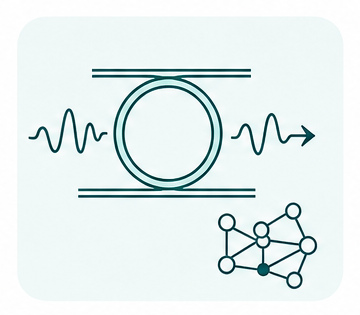
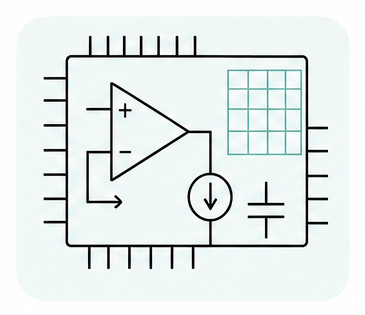
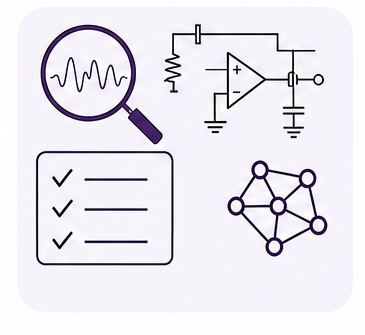
Electronic and photonic interfaces whose physical behaviour establishes system performance.
Analog front ends for the MALTA-2 and MALTA-3 monolithic active-pixel sensors at CERN.
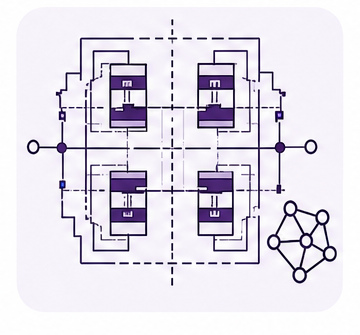
Process-aware microring-resonator modelling with compact local neural predistortion or receiver equalization.
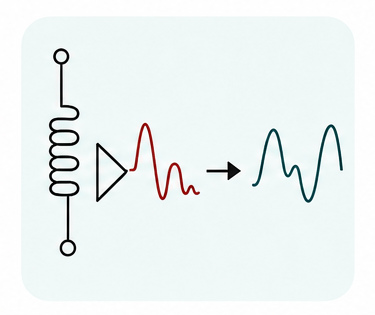
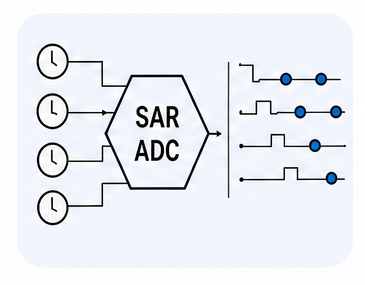
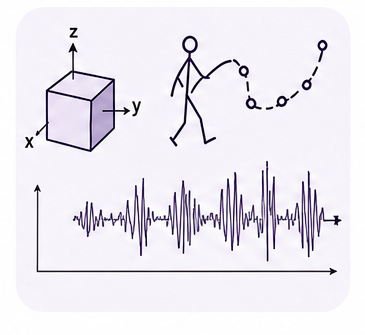
Circuit techniques for generating, conditioning, sampling, and converting high-speed signals.
Time-interleaved analog-to-digital converters.
Linearized active inductors for predistortion in RF, broadband, and optical interfaces.
High-speed analog-to-digital converters, with an intended time-interleaved SAR focus.
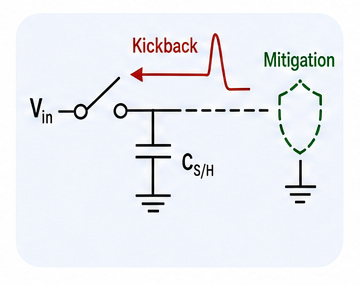
ADC sampling kickback and mitigation.
Time-to-digital converters.
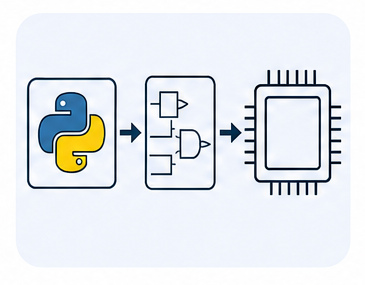
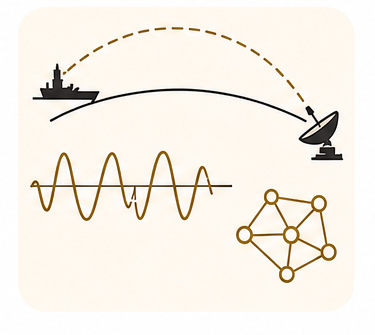
Machine intelligence embodied in hardware, and AI used to create and verify that hardware.
High-performance FPGA accelerators for AI.
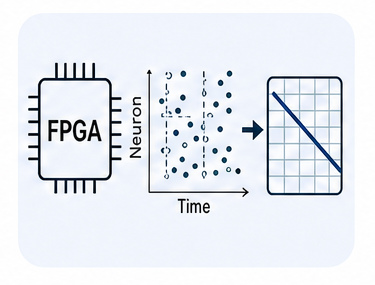
FPGA spiking neural networks for event-based gesture processing and SNN Hough transforms.
Efficient activation-function implementations in FPGAs.
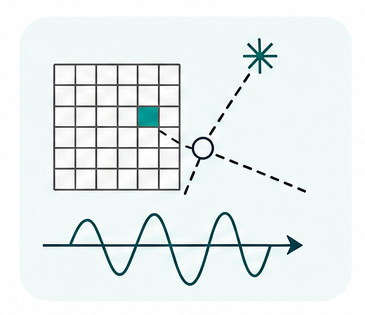
Learning and inference applied to measured signals, modulation, and system behaviour.
Language-model and sequence-model interpretation of IMU time-series data for human motion.
AI-mediated signal modulation.
This consolidated register presents the named graduate-supervision roster, including completed, active, incoming, and discontinued programs.
The supervision record is an intellectual history of the laboratory. Semiconductor-laser models led to analog predistortion and modern photonic correction; oscillator and delay research led to synthesis, TDCs, jitter analysis, CDR, and VCO-based conversion; low-voltage ADC projects developed into calibrated, reduced-capacitor, and interleaved architectures; FPGA signal processing led into current spiking and quantized AI hardware.
Samy Ghoniemy's 2004 PhD built a physical and system model for the RF/fibre optical interface. Ayman Moktar's 2007 PhD extended the modelling to isolator-free DFB laser operation with optical feedback for analog CATV applications. Fiona Shearer's 2006 MASc implemented CMOS cubic-function circuits for third-order cancellation, while Zhan Xu's 2010 PhD developed adaptive second- and third-order correction for directly modulated lasers. Together they establish a durable model-and-correct lineage.
Karim Abdelhalim's subthreshold biomedical ADCs reported 8.09 and 10.3 pJ per conversion cycle. Lado Filipovic's low-power 10-bit ADC and Octavian Stelescu's femtojoule comparator-assisted binary-search ADC extended that converter lineage. Niranjan Iyer's Vernier time-difference amplifier and Tianshuo Zhao's MCML time-to-digital converter carried the work into precision timing. Later theses developed continuous DAC-mismatch correction, reduced-capacitor SAR arrays, and algorithm-generated SAR switching sequences.
Daniel Lanfranconi's 2014 MASc developed a reduced-capacitor eight-bit SAR ADC. Octavian Stelescu's 2012 MASc developed a femtojoule-per-conversion comparator-assisted binary-search (CAB) ADC. David Berton's 2018 MASc used a backtracking algorithm to generate a 10-bit SAR switching sequence with only 25 unit capacitors. Seth Thompson's 2025 MASc combines a non-standard capacitor array, clock boosting, and a voltage-controlled delay element; schematic studies report approximately 9.5–9.7 effective bits after compensation at 10 kS/s, 1.82 μW, and 226.5 fJ per conversion step.
Ruihang Wang's 2025 MASc develops a fabricated mixed-signal SNN for Hough-transform line detection, reporting 266.1 pJ per frame in 3 mm². Jonathan Levine's 2025 MASc compiles binarized networks to bespoke FPGA hardware, with reported MNIST latencies near 85 ns and a jet-tagging example near 23 ns. These results are thesis-specific and do not imply identical performance in later systems.
This catalogue presents the graduate theses listed in the supervision record. Repository links are provided where available; entries without links retain the confirmed student, degree, year, and thesis title.
| Year | Student and thesis | Degree | Record |
|---|---|---|---|
| 2025 | Seth Thompson Interleaved SAR-ADC with Reduced Capacitors | MASc | Under embargo |
| 2025 | Ruihang Wang Application-Specific Integrated Circuit Spiking Neural Network for Parallel Hough Transform | MASc | Under embargo |
| 2025 | Jonathan Aaron Levine Hardware-Accelerated Binarized Neural Networks | MASc | Under embargo |
| 2019 | Colin Fernandes Electrospun PEDOT:PSS Electrolytic Capacitor Electrodes for Microelectronic Energy Storage | MASc | Record ↗ |
| 2018 | Ghazaleh Vazhbakht Configurable FPGA-Based Outlier Detection for Time Series Data | MASc | Record ↗ |
| 2018 | David Berton Backtracking Algorithm-Aided Design of a 10-Bit SAR ADC | MASc | Record ↗ |
| 2017 | Xinjie Wang Reduction of Power Supply Induced Jitter with Applications to DDR Controllers | PhD | Record ↗ |
| 2017 | Tianshuo Zhao A High Resolution of MCML-Based Time-to-Digital Converter Implementation | MASc | Record ↗ |
| 2017 | Satyanarayana Shashank Brahmandlapalli Determination of Bioimpedance Using Multi-Frequency Bio-electrical Impedance Analysis | MASc | Record ↗ |
| 2016 | Ruixue Wang A Low Power 8 to 1 Analog Multiplexer for Bio-Signal Acquisition System with a Function of Amplification | MASc | Record ↗ |
| 2014 | Niranjan Iyer Linearity Improvement in Vernier Delay Chain Based Time Difference Amplifiers | MASc | Record ↗ |
| 2014 | Nick Stupich Low Power Parallel Rolling Shutter Artifact Removal | MASc | Record ↗ |
| 2014 | Daniel Lanfranconi Reduced Capacitor Eight Bit SAR ADC | MASc | Record ↗ |
| 2012 | Ziad El-Khatib Highly-linearized CMOS distributed bidirectional amplifier with cross-coupled compensator for wireless communications | PhD | Record ↗ |
| 2012 | Octavian Stelescu Femto Joule per conversion 8-bit comparator assisted binary search ADC | MASc | Record ↗ |
| 2010 | Zhan Xu A predistortion circuit for direct modulated lasers for radio over fiber applications | PhD | Record ↗ |
| 2009 | Lado Filipovic Low power 10-bit ADC | MASc | Record ↗ |
| 2009 | Ghyslain Gagnon Continuous compensation of binary-weighted DAC nonlinearities in bandpass delta-sigma modulators | PhD | Record ↗ |
| 2008 | Sinisa Milicevic A frequency synthesizer with frequency divider and frequency multiplier for spur reduction | PhD | Record ↗ |
| 2007 | Karim Abdelhalim Ultra low power ADC for biomedical applications | MASc | Record ↗ |
| 2007 | Ayman Moktar Isolator-free DFB laser for analog CATV applications | PhD | Record ↗ |
| 2006 | Ziad El-Khatib Fully-integrated fully-differential silicon RF CMOS distributed amplifier based on multi-Tanh linearization principle | MASc | Record ↗ |
| 2006 | Fiona Shearer CMOS analog cubing circuits for radio-over-fiber predistortion | MASc | Record ↗ |
| 2006 | Daniel Olszewski Tunable filter and receive signal strength indicator for detecting whitespace in the frequency spectrum | MASc | Record ↗ |
| 2006 | Celine Fletcher VCO phase noise reduction technique | MASc | Record ↗ |
| 2005 | Yasser Soliman CMOS LNA for impulse-radio UWB | MASc | Record ↗ |
| 2005 | Sinisa Milicevic A multi-band voltage-controlled ring oscillator | MASc | Record ↗ |
| 2005 | Mark Houlgate Adaptable MOS current mode logic for multi-band frequency synthesizers | MASc | Record ↗ |
| 2004 | Samy Ghoniemy RF/fiber optical interface for microcellular wireless transceivers | PhD | Record ↗ |
Students work across levels of abstraction: physical plant and measurement, device and circuit models, schematic and layout, digital support logic, FPGA or ASIC mapping, software tooling, and the evidence needed to decide whether a result is valid.