MALTA2 Boundary-Loss Surrogate for Asynchronous MAPS Readout
CERN, event-driven MAPS readout, and an analytic model connecting charge sharing, pixel grouping, address encoding, and tracking loss.
What this research is about
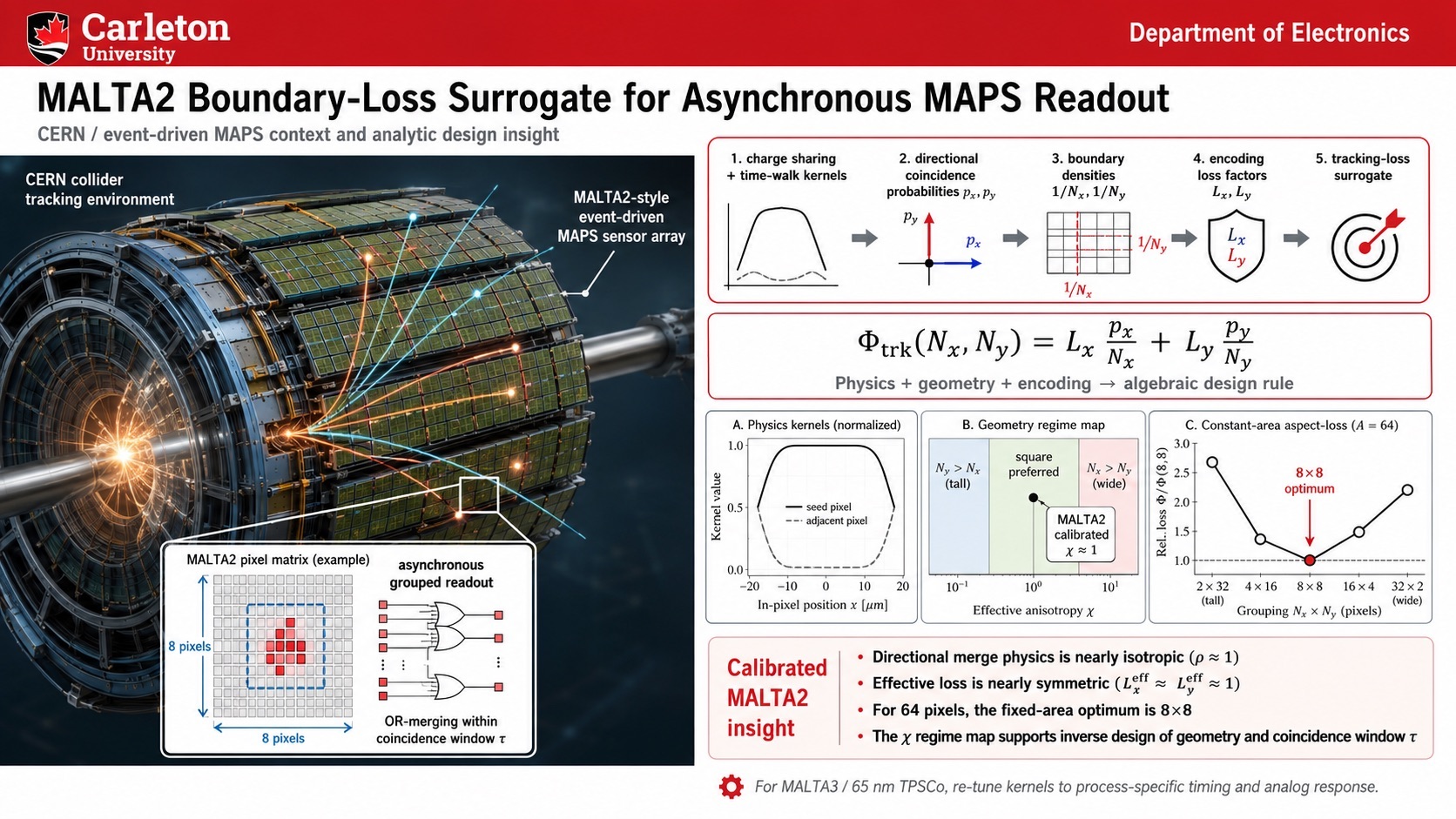
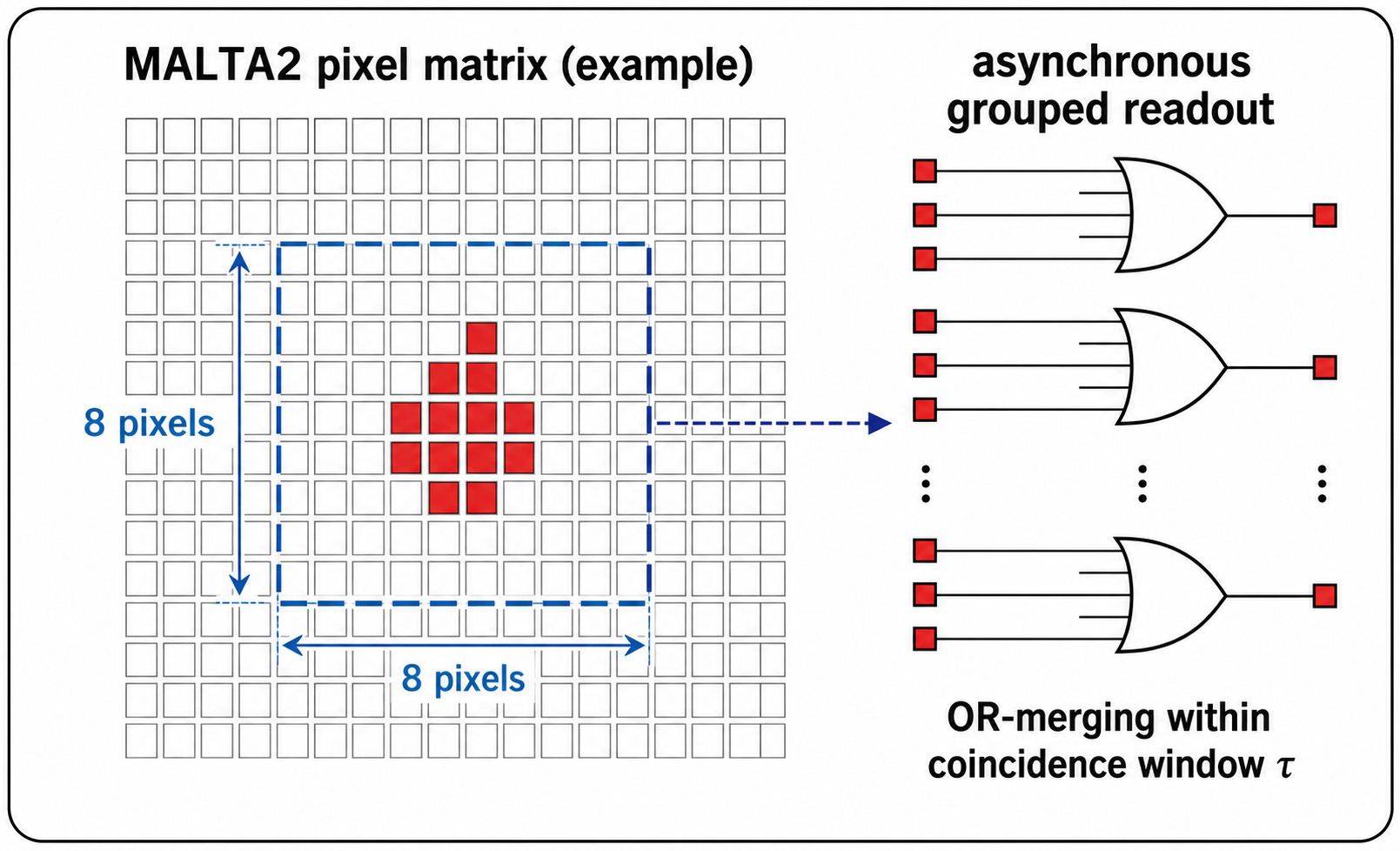
MALTA2 uses an event-driven pixel readout for recording particle tracks. To reduce the amount of data leaving the sensor, nearby pixel addresses that arrive almost simultaneously can be combined with a bitwise OR. That saves bandwidth, but it can also create a decoded address that no longer points to the original hit; if the shift is too large, tracking may reject a real particle hit.
This work condenses that chain of effects into a compact model linking charge sharing and timing, pixel-group boundaries, address encoding, and tracking loss. It makes it possible to compare group shapes and coincidence windows without rerunning a full detector simulation for every design choice. At the calibrated MALTA2 operating point, the two pixel directions behave almost symmetrically, making an 8×8 arrangement the preferred shape for a 64-pixel group.
Directional merge physics is nearly isotropic (ρ ≈ 1).
Effective encoding loss is nearly symmetric (Lxeff ≈ Lyeff ≈ 1).
For 64 pixels, the fixed-area optimum is 8×8.
The regime map supports inverse design of geometry and coincidence window τ.
Growing CERN relationship: detector expertise, electronics, modelling, and future measurements meet at a shared calibration interface. For MALTA3 in 65 nm TPSCo, the kernels must be retuned to the process-specific timing and analog response.
01 · Physical process
From charge sharing to a merged address
The model begins with the seed- and adjacent-pixel response kernels. These determine how likely two pixel addresses are to arrive inside the same coincidence window and therefore be merged by the asynchronous readout.
02 · Architectural consequence
Boundaries turn local coincidences into tracking loss
A merged address can cross a group boundary or acquire bits from two neighbouring hits. Boundary density, directional coincidence probability, and encoding loss therefore connect the pixel geometry to a track-level observable.
03 · Design use
Compare group geometry without a full detector run
Once calibrated, the surrogate supports rapid comparison of group shapes and timing windows. It does not replace detailed detector simulation; it provides a compact inverse-design rule for deciding which configurations merit that expense.