Projection-Aware Approximation for Efficient AI Accelerators
Downstream qualification selects a narrower replicated GELU bank.
Current research
An investigation into activation-function efficiency
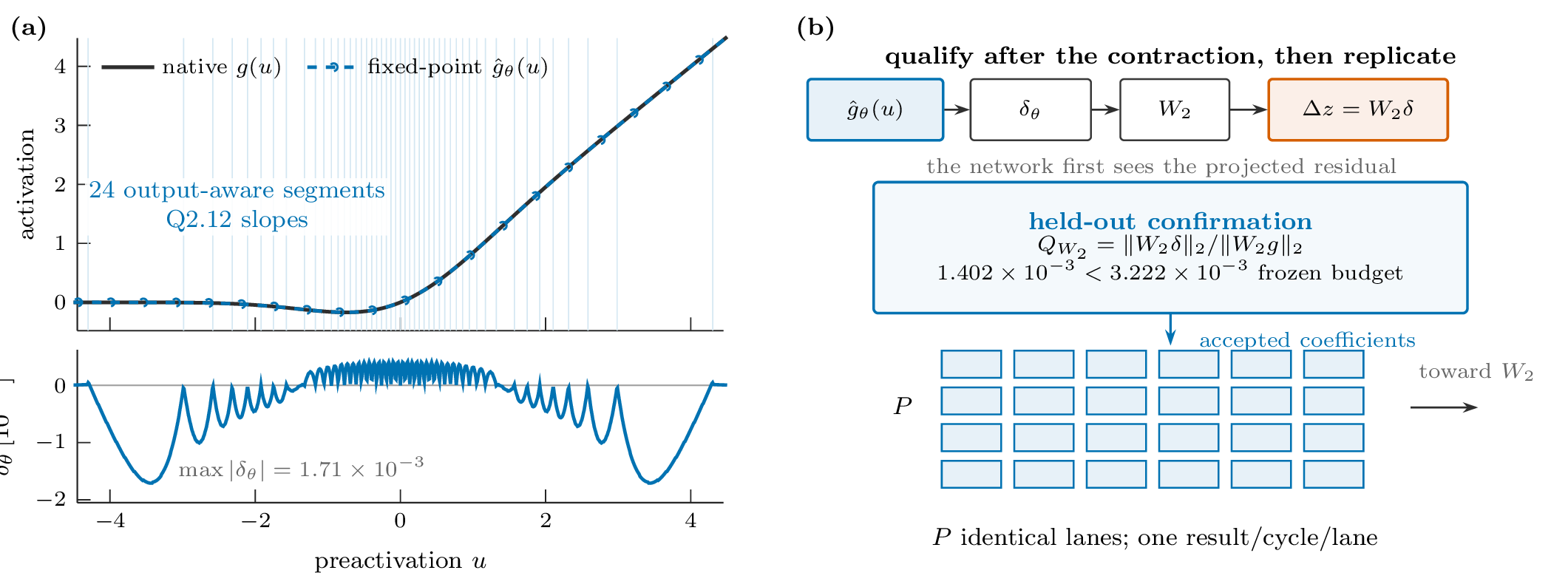
This work is an investigation into activation-function efficiency for AI accelerators. Instead of asking only how closely a piecewise-linear circuit reproduces scalar GELU, it asks how much of that error survives the following W2 contraction and can therefore affect the deployed network.
01 · Workload qualification
Qualify after the contraction, then replicate
A 24-segment fixed-point GELU with Q2.12 slopes is admitted only after its residual is projected through W2. On the frozen held-out workload, the selected candidate's projected error is 0.001402, below the 0.003222 budget. Accepted coefficients are then replicated across identical lanes.
Research figure re-rendered for the web. Select it to open the vector PDF.
02 · Candidate selection
Separate breakpoint placement from arithmetic precision
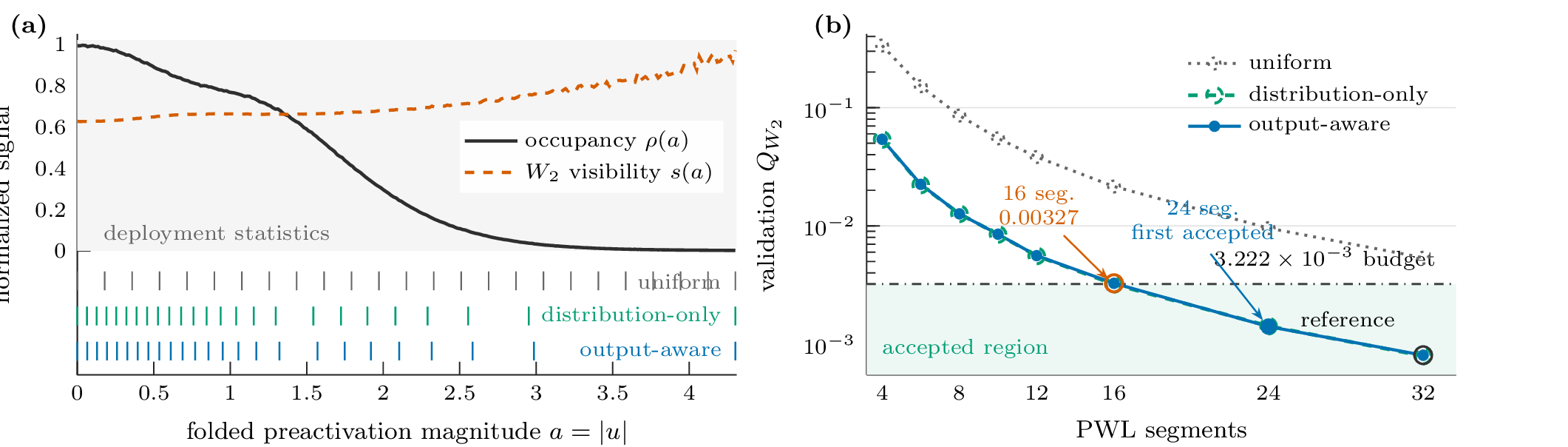
The search first establishes a held-out deployment budget, then evaluates segment count, breakpoint construction, and fixed-point formats as distinct choices. Output-aware and distribution-only breakpoint placement were effectively tied on this workload; the decisive implementation gain came from reducing slope precision.
The staged selection procedure prevents a hardware-friendly format from being accepted until it clears the downstream fidelity test.
03 · Hardware consequence
Precision reduction propagates through every lane
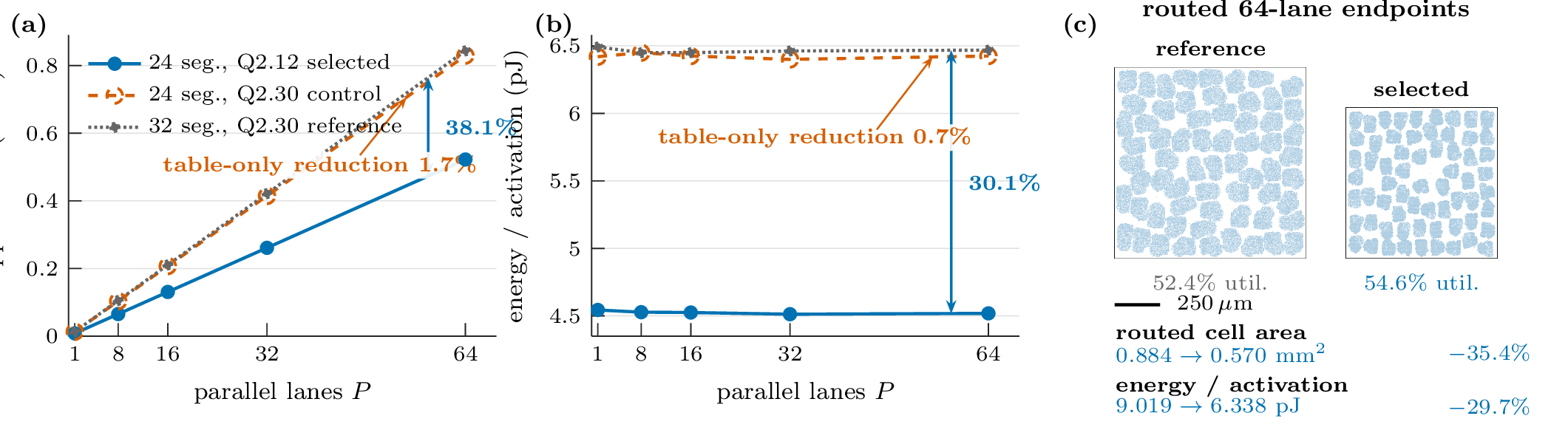
Reducing the table from 32 to 24 entries contributes little by itself. Moving from Q2.30 to Q2.12 slopes narrows the multiplier and product register in every replicated lane—from 65 to 47 bits—while retaining one result per cycle per lane.
04 · Realized endpoint
The savings persist through physical implementation
All fifteen banks across five lane counts and three coefficient formats passed RTL and mapped gate simulation. The selected and reference 64-lane endpoints were also routed, checked for connectivity and design-rule violations, exercised with complete switching activity, and compared at the available worst-case timing view.
Mapped scaling across 1, 8, 16, 32, and 64 lanes, followed by the two routed 64-lane endpoints.
What is new
The approximation is qualified where it matters to the deployed computation: after the next linear contraction, rather than from scalar activation error alone.
What the evidence supports
On this fixed DistilGPT2 deployment, a downstream-qualified 24-segment Q2.12 GELU bank reduces replicated arithmetic cost without exceeding the frozen projected-error budget.
Scope of the result
The study covers one model and corpus, fixed coefficients, and the GELU bank itself. Matrix arrays, SRAM, and data movement are outside the reported area and energy estimates; the implementation is not tapeout sign-off.