
Facilities and Infrastructure
Laboratory Notes and Facility Concepts
The current manual treats laboratory support as part of normal departmental planning rather than as a standalone capital proposal. This page keeps the visual and instructional context while presenting lab concepts at a scale that fits the current stream pathway.
Planning Position
The stream pathway remains modest in curricular scope, and the manual now treats laboratory delivery as part of normal departmental planning. That means the website can still show what good instructional support could look like while keeping the discussion at a planning level.
In practice, that points to a mixed model: departmental Electronics laboratories would continue to carry much of the baseline delivery, while photonics-specific, packaging-oriented, and software/design support would be developed at a scale appropriate to the pathway and available resources.
The concepts below are therefore best read as illustrative laboratory patterns for
ELEC 2PHO, ELEC 4702, ELEC 4CPO, and
ELEC 4SPD, together with the kinds of tools that would make those experiences strong.
Facility Preview
The media below is intentionally retained as a visual reference for the kind of environment that supports hands-on photonics, instrumentation, packaging, and design work well.
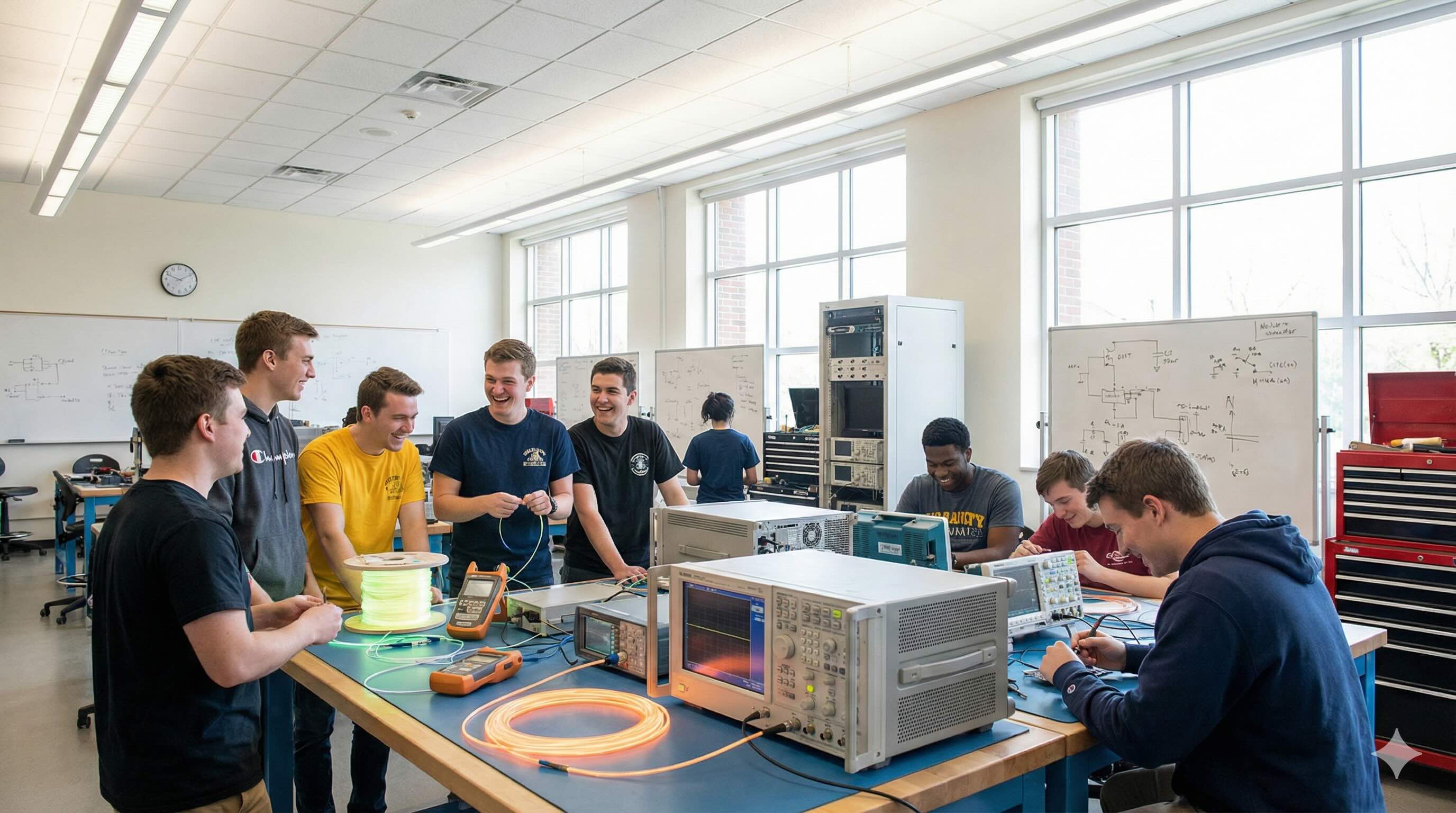
Optical Systems & Fiber Laboratory Concept
Illustrative fit: ELEC 2PHO, ELEC 4702
A good optical lab for this pathway would focus on safe handling, connector inspection, basic alignment, power measurement, attenuation, and introductory link characterization. The emphasis would be on repeatable measurement routines rather than on an expansive fabrication environment.
At a modest scale, the strongest setup would combine per-station essentials with a smaller pool of shared instruments for more specialized exercises.
| Item | Illustrative Qty | Teaching Use |
|---|---|---|
| Optical breadboards or stable work surfaces | 6-10 | Basic alignment, source-detector setups, and repeatable introductory optics labs. |
| Optical power meters | 10 | Insertion-loss checks, power-budget exercises, and detector characterization. |
| Laser or source modules | 5-10 | Controlled source options for guided measurement work at common telecom wavelengths. |
| Variable optical attenuators | 6-10 | Channel-loss emulation and receiver-margin demonstrations. |
| Inspection scopes or probes | 6-10 | Connector inspection, cleanliness practice, and fault identification. |
| Shared OTDR or link-analysis tools | 1-2 | Guided demonstrations and advanced characterization exercises. |
High-Speed Data Links and Signal Integrity Concept
Illustrative fit: ELEC 4702, ELEC 4CPO
To connect optical-link ideas with real hardware, a strong upper-year lab would include instrumentation for eye-diagram work, jitter-aware measurement, channel characterization, and structured debugging of high-speed electrical interfaces.
Here again, a balanced model works best: routine scopes and fixtures at the bench level, with higher-end analyzers shared across the class for deeper measurement labs.
| Item | Illustrative Qty | Teaching Use |
|---|---|---|
| Real-time oscilloscopes | 8-10 | Bench-level debugging, waveform capture, and routine verification. |
| Differential or high-speed probes | 8-10 | Electrical link measurements and controlled SI experiments. |
| Shared sampling scopes or DCA systems | 1-3 | Eye-diagram and jitter demonstrations at higher data rates. |
| Bit-error-rate test equipment | 1-3 | Stress testing and controlled link-quality exercises. |
| Vector network analyzers | 1-2 | Channel-loss and return-loss analysis for boards, fixtures, and connectors. |
| Reference fixtures and breakout hardware | 5-10 | Repeatable teaching setups for channel and packaging experiments. |
Packaging, Assembly, and Inspection Concept
Illustrative fit: ELEC 4CPO
For co-packaged optics and related instruction, students benefit from seeing packaging as an engineering problem, not just a packaging afterthought. A good lab concept here would emphasize inspection, interconnect, thermal awareness, and testability.
The point is not to recreate a full production suite. It is to create a clean, well-supported teaching environment for assembly-oriented exercises and guided demonstrations.
| Item | Illustrative Qty | Teaching Use |
|---|---|---|
| Stereo microscopes | 8-10 | Inspection, alignment checks, and close-view assembly work. |
| Manual bonders or attach tools | 1-2 | Guided demonstrations and small-group packaging exercises. |
| Precision stages or pick-and-place support | 1-2 | Component placement and handling demonstrations. |
| Thermal test equipment | 1-2 | Temperature-related performance checks and reliability discussions. |
| Benchtop curing or process support tools | 1-2 | Controlled assembly workflows for adhesives and package preparation. |
| Fume extraction and local cleanliness controls | As needed | Safe bench operation for soldering, cleaning, and assembly-oriented work. |
Silicon Photonics Design and Simulation Concept
Illustrative fit: ELEC 4SPD
The design side of the stream depends less on bench hardware and more on dependable compute, software, and instructional support. A good lab model would provide students with enough capacity to run layout, simulation, and verification workflows without turning every exercise into a queue-management problem.
This is also the area where incremental support can often be introduced most pragmatically through software licenses, workstation planning, and managed teaching images.
| Item | Illustrative Qty | Teaching Use |
|---|---|---|
| Workstations or capable managed lab machines | 10-20 | Simulation-heavy design exercises and layout work. |
| Photonic simulation licenses | Course-scale pool | Component and circuit modeling for upper-year design activities. |
| Layout and verification tool access | Course-scale pool | PDK-aware layout, checking, and design review workflows. |
| Shared storage and version-control support | Program-level | Team-based design iteration, submission management, and reproducible coursework. |
Safety and Support Considerations
If the stream grows into regular photonics delivery, the strongest implementation would pair the instructional concepts above with practical operational support:
- laser-safety procedures, training, and appropriate protective equipment;
- bench-level controls for optical handling, extraction, and cleaning workflows;
- technical support for calibration, setup, and software-image maintenance; and
- incremental planning through normal departmental and university approval processes.
That framing stays aligned with the manual: the stream would rely on departmental resources, and any incremental laboratory, software, safety, or technical-support needs would be developed through normal planning rather than embedded as commitments in the curriculum itself.