AI-Assisted VCO-ADC Calibration and Profile Validation
Interruptive profile validation, engineer-in-the-loop implementation, and three realized 65-nm backends.
Why validate a stored correction profile?
A ring-oscillator VCO-ADC can suppress distortion with a stored digital correction profile, but process, voltage, temperature, ageing, or operating-point drift can make that profile stale. This work treats the brief validity check as part of the design itself: a known-stimulus record is reduced to a small set of residual spectral lines, each line is tested against its own allocated mask, and the controller decides whether to keep the active profile, switch to another stored profile, or recalibrate. It is an independent research-in-progress passion project pursued by Leonard MacEachern.
System context and evidence boundary
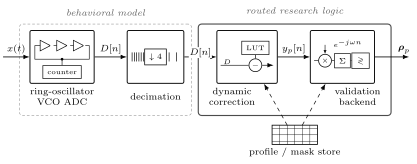
The VCO-ADC source and decimator supply behavioural validation records; correction and validation logic is routed in a commercial 65-nm flow. Profile, mask, reference, and record storage are accounted separately.
Profile-validation loop
Acquire a known record.At production trim, startup, idle maintenance, scheduled self-test, or an event-triggered check, a known validation tone briefly interrupts normal conversion.
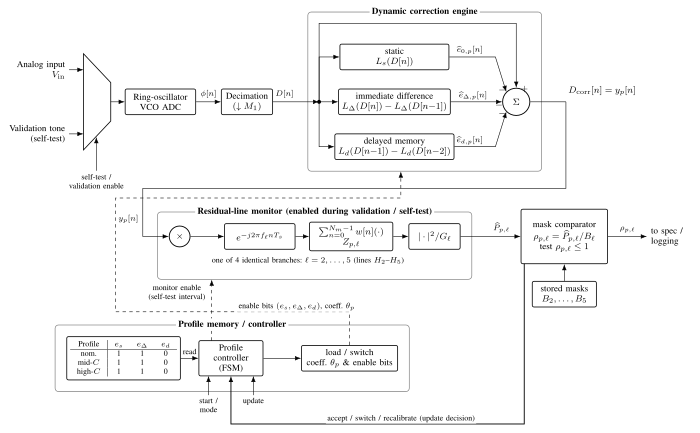
Apply the candidate profile.The decimated sequence D[n] passes through stored static, immediate-difference, and delayed-memory correction terms to produce the corrected stream yp[n].
Measure only the diagnostic lines.Four coherent selected-bin branches estimate the residual H₂–H₅ line powers from an 8192-sample record instead of computing a complete spectrum.
Preserve the product mask.Each line power is normalized by its allocated mask Bℓ, producing ρp,ℓ. The full ratio vector is retained because a summed residual can hide a single line that exceeds its mask.
Make the profile decision.If the active profile passes, it is kept. If an alternate stored profile passes, the controller switches. If none passes—or a result falls in the guard region—the controller requests recalibration.
Score the interruption.Because validation temporarily occupies the converter, the relevant measures are interruption time, energy per check, and peak active load—not arithmetic count alone.
Detailed correction and profile-validation architecture
The upper path forms the corrected stream from static, immediate-difference, and delayed-memory terms. During a validation interval, four coherent H₂–H₅ branches form the per-line ratio vector; the controller then keeps or switches the stored profile, or requests recalibration.
Physical implementation
Three routed validation backends
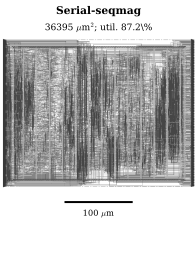
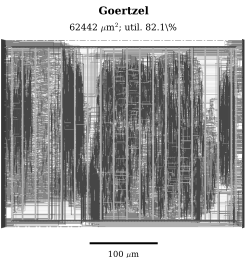
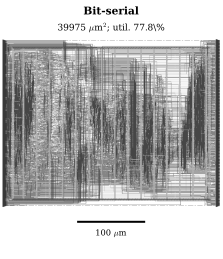
DEF-derived layouts from the current research implementation are presented on the same physical scale. Labels report core area and utilization; the standard-cell areas appear in the backend comparison above.
Each panel includes a 100 μm scale bar. The Goertzel core is visibly the largest; the bit-serial backend reduces concurrent arithmetic but pays for it in a much longer validation interruption.
Mathematics led by the researcher; implementation accelerated by AI
Mathematics and system architecture
Leonard MacEachern derived the fundamental mathematics: the dynamic-correction basis, selected residual-line formulation, per-line ratio-vector decision rule, guard semantics, and implementation objectives used to compare the validation backends.
AI-assisted, engineer-in-the-loop implementation
AI was used to drive coding, synthesis, placement and routing, timing-closure iterations, and power-estimation tools. The engineer remained in the loop throughout—setting the mathematical specification and constraints, reviewing generated RTL and tool reports, selecting corrective actions, and checking the realized hardware against the intended decision rule.
Implementation highlights
Three alternative logic-only active-validation backends implement the same residual-line ratio-vector rule.
All three achieve positive post-route setup and hold at 500 MHz, with zero Innovus DRC and connectivity violations in the reported flow.
The serial-seqmag backend validates two profiles in 0.132 ms and 1.72 μJ; aggressive bit serialization reduces concurrent arithmetic but extends the interruption to 8.259 ms and 92.13 μJ.
Correction LUTs, profile memories, masks, reference content, and validation-record buffers are excluded from the routed logic blocks and accounted separately.