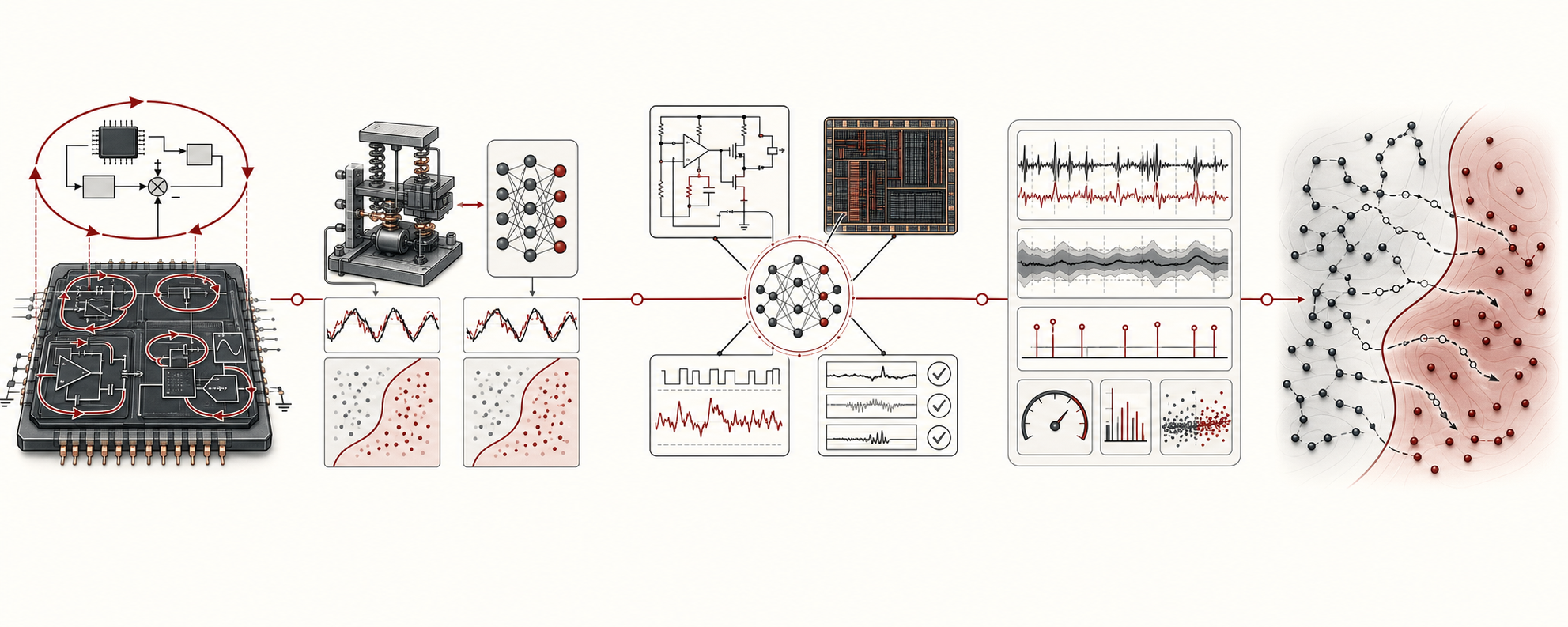
Research directions in adaptive architecture, surrogates, automated research, design telemetry, and stochastic processes.
Five connected directions: adaptive architecture, observable-preserving models, auditable design, live solution telemetry, and stochastic computation.
01
Architecture and control
Hierarchical in-circuit intelligence
A documented 2025 research-program concept organizes adaptation into local monitors and correctors, intermediate coordination, and system-level supervision. Its established antecedents include ADC/DAC calibration, laser predistortion, FPGA outlier detection, wearable sensing, quantized hardware, and verification. The program includes proposed 65 nm structures, a publication pathway, and a five-year research agenda.
A surrogate is judged by whether it preserves the observable and decision boundary needed by the application. This principle connects semiconductor-laser and microring models, converter profiles, detector boundary-loss formulas, workload-weighted nonlinear approximations, and reduced computational controllers.
03
Design and evidence
AI-assisted circuit design and verification
Current work investigates test generation, simulator orchestration, waveform and spectrum interpretation, failure triage, analog-layout constraints, RTL generation, and evidence manifests. The research contribution is the auditable loop between intent and evidence: which constraints were supplied or inferred, which test supports a claim, and whether the result survives a tool, PDK, or operating-point change.
Residuals, uncertainty, correction frequency, rank changes, coverage, and boundary events can make a solving process observable while it runs. The same idea can monitor adaptive circuits, optimization, surrogate validity, diffusion sampling, and AI-generated design actions.
05
Stochastic computation
Diffusion and stochastic boundaries
A research program studies when expensive predictor-corrector evaluations in diffusion sampling may be skipped using interface telemetry while protecting declared quality quantities. The work examines how telemetry can reduce computation while protecting declared quality quantities in speed-, energy-, and semantics-sensitive applications.